My fellow CreCommers and I went to see a play at the Rachel Browne Theatre called Dionysus in Stony Mountain. The title of the play could have served as a warning for me about the complex language and concepts I was about to sit through, as I had never heard of the Greek god Dionysus.
Having seen the play now, I still don't really understand the title's connection. The character James (Ross McMillan) gets a prison tattoo of Dionysus on his arm, and explains a bit about him to his psychiatrist, Heidi (Sarah Constible). But this conversation was a bit over my head, as was much of the first half of the play.
The first half takes place in Stony Mountain, during a session between James and Heidi, after James has stopped taking his lithium, and started memorizing quotes from the German philosopher Nietzsche. James spends most of the session ranting about his new beliefs and views on the world, and often quoting at length from Nietzsche's writing.
The language is very heavy. But I think that even though I didn't understand much of it, that didn't take away from my experience of the story. I don't think James is meant to be completely understood by your average person meeting him for the first time.
The second half was easier to digest. Constible still played Heidi, though no longer a psychiatrist, and McMillan switched characters to play Heidi's uncle, checking up on her at her mother's request.
Heidi's uncle brought a lot more comedy to the play. He's a jaded businessman who enjoys taking jabs at Heidi and her new life. He also speaks much simpler than James did in the first half.
I haven't been to many plays, but I think the acting in Dionysus in Stony Mountain was incredible. Each half was around 55 minutes long, and the shear fact that these two actors could remember that many lines is commendable to me. The fact that they could deliver that many lines emotionally and convincingly is nothing short of amazing.
I felt like McMillan did an outstanding job switching roles. Had I not been told earlier, I may not have known it was still him in the second half.
But the play did drag a bit. The first half was a long time to pay as much attention as I felt the dialogue needed me to. The second half should have been easier, but I felt my mind was already pretty exhausted from the first half.
Overall it was a good experience. It was very interesting to see how much a script can do with just two people talking.
Showing posts with label review. Show all posts
Showing posts with label review. Show all posts
Tuesday, April 10, 2012


Thursday, March 29, 2012
ASSIGNMENT - "Journey for Justice" discussion for Journalism
In class we read the true-crime book Journey for Justice: How 'Project Angel' Cracked the Candace Derksen Case.
It was written by Mike McIntyre, and it details the events of Candace Derksen's disappearance, death, and the eventual trial of her killer, Mark Grant.
The book feels like it has two sections with two different styles of writing. The first section deals with the initial disappearance of Candace, and the search for her. This section reads much like a regular novel.
As this was the first true-crime book I've ever read, I wasn't expecting this style at all. I was pleasantly surprised. I think the style works because it kept me interested in what would happen next, as it was told as a story. It also made me feel a connection to the characters, as McIntyre used lots of dialogue, much of it from Wilma Derksen's (Candace's mother) own book, Have You Seen Candace?
The second section looks at the trial of Mark Grant. I lost some of my interest reading this part because it was written the way I expected a true-crime book to be written: lots of facts, legal jargon, newspaper articles, and psychiatric reports. While some of these things were interesting, a lot of it was over my head or repetitive.
The main thing this section loses out on, is the connection to the characters I felt in the first part of the book.
I think that journalists can learn the importance of emotional content from this book. While getting the facts straight is the top priority of a journalist, it is only the skeleton of a story. I believe that all stories can be improved by the thoughts and feelings of the people involved in the story. This is why I enjoyed the first half of the book more than the second.
I saw a documentary called Dear Zachary: A Letter to a Son About His Father, which also deals with a murder case. When I compare these two works, it strengthens my thoughts on emotional value. Dear Zachary shows the struggle of a murdered man's parents to gain custody of his daughter from the woman they believe murdered him.
Seeing how they feel and think is what makes the film so interesting. They also give factual information, but it doesn't bog down the story like the end of Journey for Justice. Although, I did feel that Journey for Justice felt like much more of a journalism piece than Dear Zachary, as the director of Dear Zachary was a friend of the deceased and very involved in the story.
After reading Journey for Justice, Mike McIntyre and Wilma Derksen came to Red River to speak to us. It was interesting to hear how the book came to be, but I would have liked to hear more of what Wilma had to say, as McIntyre did most of the talking. I was amazed reading the book and listening to Wilma speak, at how loving and forgiving she is. It's hard for me to understand how she doesn't, and never did, let anger towards Grant overwhelm her.
Overall, the book was a very interesting read and I recommend it to anyone who enjoys true-crime books, or those who haven't read one. It was nice to see that good story telling can thrive in these kinds of books.
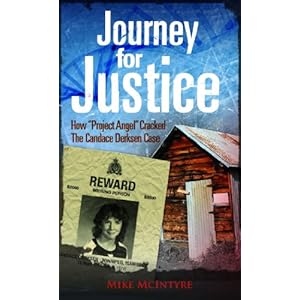 |
| Cover of Journey for Justice. |
The book feels like it has two sections with two different styles of writing. The first section deals with the initial disappearance of Candace, and the search for her. This section reads much like a regular novel.
As this was the first true-crime book I've ever read, I wasn't expecting this style at all. I was pleasantly surprised. I think the style works because it kept me interested in what would happen next, as it was told as a story. It also made me feel a connection to the characters, as McIntyre used lots of dialogue, much of it from Wilma Derksen's (Candace's mother) own book, Have You Seen Candace?
The second section looks at the trial of Mark Grant. I lost some of my interest reading this part because it was written the way I expected a true-crime book to be written: lots of facts, legal jargon, newspaper articles, and psychiatric reports. While some of these things were interesting, a lot of it was over my head or repetitive.
The main thing this section loses out on, is the connection to the characters I felt in the first part of the book.
I think that journalists can learn the importance of emotional content from this book. While getting the facts straight is the top priority of a journalist, it is only the skeleton of a story. I believe that all stories can be improved by the thoughts and feelings of the people involved in the story. This is why I enjoyed the first half of the book more than the second.
I saw a documentary called Dear Zachary: A Letter to a Son About His Father, which also deals with a murder case. When I compare these two works, it strengthens my thoughts on emotional value. Dear Zachary shows the struggle of a murdered man's parents to gain custody of his daughter from the woman they believe murdered him.
Seeing how they feel and think is what makes the film so interesting. They also give factual information, but it doesn't bog down the story like the end of Journey for Justice. Although, I did feel that Journey for Justice felt like much more of a journalism piece than Dear Zachary, as the director of Dear Zachary was a friend of the deceased and very involved in the story.
After reading Journey for Justice, Mike McIntyre and Wilma Derksen came to Red River to speak to us. It was interesting to hear how the book came to be, but I would have liked to hear more of what Wilma had to say, as McIntyre did most of the talking. I was amazed reading the book and listening to Wilma speak, at how loving and forgiving she is. It's hard for me to understand how she doesn't, and never did, let anger towards Grant overwhelm her.
Overall, the book was a very interesting read and I recommend it to anyone who enjoys true-crime books, or those who haven't read one. It was nice to see that good story telling can thrive in these kinds of books.
Monday, September 26, 2011
ASSIGNMENT - "Page One" Movie Review for Journalism
On Friday, my fellow first year Cre Commers and I went to see a documentary called Page One at the Cinematheque.
The film looks at the inner workings of the New York Times and poses the question: is the news paper dying? It follows New York Times writers Brian Stelter, Tim Arango, and my favorite, David Carr.
I enjoyed the movie as a whole, but Carr really makes it worth watching all on his own. His down to earth nature and wit are hilarious, and somewhat surprising for me to see at such a prestigious news paper. Carr is completely blunt while conducting interviews, sometimes swearing like a sailor. I would have thought that would get you fired from a company like the New York Times, but he creates great work with his style.
The documentary mainly focuses on the battle between online information and the newspaper, a battle the newspaper is apparently losing. But that being said, the newspaper has been apparently losing since it was created.
In my opinion, the newspaper does provide something blogs and twitter don't, and that's a sense of verification. I feel like newspapers can be trusted because they work very hard to keep that true. Also, bloggers and people tweeting don't tend to actually go out and experience the things they write about, whereas newspapers have an entire team of people gathering information for their stories. This leads me to believe that a lot of things on the internet are probably just rehashed from the paper.
That being said, there was a very good line in the movie that went something like "there is a difference between newspapers can't die, and newspapers shouldn't die". While I agree newspapers have their purpose, I can't guarantee that will keep them around.
Overall I felt Page One did a good job shedding light on the situation and I'd recommend anyone to go see it.
 |
| Poster for Page One. |
The film looks at the inner workings of the New York Times and poses the question: is the news paper dying? It follows New York Times writers Brian Stelter, Tim Arango, and my favorite, David Carr.
I enjoyed the movie as a whole, but Carr really makes it worth watching all on his own. His down to earth nature and wit are hilarious, and somewhat surprising for me to see at such a prestigious news paper. Carr is completely blunt while conducting interviews, sometimes swearing like a sailor. I would have thought that would get you fired from a company like the New York Times, but he creates great work with his style.
The documentary mainly focuses on the battle between online information and the newspaper, a battle the newspaper is apparently losing. But that being said, the newspaper has been apparently losing since it was created.
In my opinion, the newspaper does provide something blogs and twitter don't, and that's a sense of verification. I feel like newspapers can be trusted because they work very hard to keep that true. Also, bloggers and people tweeting don't tend to actually go out and experience the things they write about, whereas newspapers have an entire team of people gathering information for their stories. This leads me to believe that a lot of things on the internet are probably just rehashed from the paper.
That being said, there was a very good line in the movie that went something like "there is a difference between newspapers can't die, and newspapers shouldn't die". While I agree newspapers have their purpose, I can't guarantee that will keep them around.
Overall I felt Page One did a good job shedding light on the situation and I'd recommend anyone to go see it.
Subscribe to:
Posts (Atom)